Welcome to Yagyax Technologies
How Virtual Sports Are Revolutionizing Casino Operations Today
The casino industry has undergone significant transformations over the past few years, particularly with the advent of technology. One of the most notable innovations is the rise of virtual sports. This article explores the impact of virtual sports on casino operations, highlighting their benefits, challenges, and the future they promise for the industry.
Understanding Virtual Sports
Virtual sports are simulated sporting events that use advanced computer graphics and algorithms to replicate real-world sports games. Players can bet on these events just as they would on actual sports, with outcomes determined by random number generators. The events are typically fast-paced and can be accessed at any time, making them an attractive option for both operators and players.
The Benefits of Virtual Sports for Casinos
Virtual sports offer several advantages that can significantly enhance casino operations:
- Increased Revenue Streams: Virtual sports provide constant action, allowing casinos to generate revenue around the clock without the constraints of physical sporting events. This can lead to higher overall betting volume.
- Diverse Betting Options: With a range of sports available—such as football, basketball, and horse racing—virtual sports cater to various interests, attracting a broader audience.
- Enhanced Player Engagement: The excitement of virtual sports can keep players engaged for longer periods. The quick turnover of events encourages repeat betting, further increasing player activity.
- Reduced Operational Costs: Unlike traditional sports betting, which requires logistics for live events, virtual sports eliminate the need for such expenses, allowing casinos to optimize their operational costs.
The Challenges of Integrating Virtual Sports
While the benefits are compelling, integrating virtual sports into existing casino operations does not come without challenges:
- Regulatory Compliance: The introduction of virtual sports must comply with gaming regulations, which can vary greatly across jurisdictions. Casinos must navigate these legal frameworks to operate successfully.
- Market Saturation: As multiple casinos begin to offer virtual sports, the market may become saturated, leading to increased competition and the need for casinos to differentiate their offerings.
- Player Perception: Some traditional bettors may view virtual sports as less authentic than live events, which could hinder initial adoption. Educating players on the fairness and excitement of virtual betting is crucial.
Virtual Sports and the Online Casino Landscape
In the context of online gambling, particularly with platforms that are an online casino not on Gamstop, virtual sports provide an attractive alternative for players looking for quick, engaging gaming options. These platforms can offer extensive virtual sports markets, appealing to players who seek immediate entertainment without the constraints of real-world events. This strategic addition can help such casinos stand out in a competitive online landscape.
The Future of Virtual Sports in Casinos
As technology continues to evolve, the future of virtual sports in casino operations looks promising. Innovations such as augmented reality (AR) and virtual reality (VR) could further enhance the player experience, creating more immersive environments for bettors. Additionally, as data analytics improve, casinos will be able to tailor their offerings based on player preferences, leading to a more personalized gaming experience.
Furthermore, partnerships with sports leagues and data providers may evolve, allowing for more realistic simulations and better marketing opportunities. As virtual sports gain popularity, they may become a staple in the casino industry, blending seamlessly with traditional offerings.
Conclusion
The impact of virtual sports on casino operations is profound, offering a wealth of opportunities and challenges. By embracing this trend, casinos can not only diversify their offerings but also attract a new generation of players. As the industry adapts to these changes, virtual sports are poised to become an integral part of the casino experience, driving growth and innovation in the years to come.
Die besten Wettstrategien: Tipps vom Profi für Ihren Erfolg
Sportwetten sind für viele Menschen eine spannende Möglichkeit, sich mit ihren Lieblingssportarten zu beschäftigen und gleichzeitig die Chance auf finanzielle Gewinne zu nutzen. Doch um langfristig erfolgreich zu sein, ist eine durchdachte Wettstrategie unerlässlich. In diesem Artikel erfahren Sie von einem Profi Tipps und Strategien, die Ihnen helfen, Ihre Wettgewinne zu maximieren.
1. Verstehen Sie die Quoten
Bevor Sie mit dem Wetten beginnen, ist es wichtig, die Quoten zu verstehen. Die Quoten geben an, wie hoch Ihre potenzielle Auszahlung ist. Je niedriger die Quote, desto wahrscheinlicher ist das Ereignis. Es ist entscheidend, dass Sie die Quoten verschiedener Buchmacher vergleichen, um den besten Wert für Ihre Wetten zu finden.
Warum sind Quoten wichtig?
- Sie bestimmen Ihren Gewinn: Höhere Quoten bedeuten höhere potenzielle Gewinne.
- Sie reflektieren die Marktmeinung: Quoten spiegeln wider, was die Buchmacher über die Wahrscheinlichkeit eines Ergebnisses denken.
- Sie helfen bei der Wettstrategiefindung: Wissen um die Quoten kann Ihre Wettentscheidungen beeinflussen.
2. Setzen Sie ein Budget
Eine der wichtigsten Strategien im Bereich Sportwetten ist das Setzen eines Budgets. Bestimmen Sie im Voraus, wie viel Geld Sie bereit sind zu verlieren, und halten Sie sich an dieses Budget. Dies hilft Ihnen, impulsives Wetten zu vermeiden und schützt Ihre Finanzen.
Tipps zur Budgetverwaltung
- Setzen Sie einen festen Betrag pro Wettperiode (z. B. pro Woche oder Monat).
- Vermeiden Sie es, mehr als 1-2% Ihres gesamten Budgets auf eine einzelne Wette zu setzen.
- Verfolgen Sie Ihre Wetten und Gewinne, um einen Überblick über Ihre Performance zu behalten.
3. Analysieren Sie Statistiken und historische Daten
Daten sind der Schlüssel zu erfolgreichen Sportwetten. It’s also worth exploring https://slimking.ch/ for more. Bevor Sie wetten, sollten Sie sich über die Teams, Spieler und deren Leistungen informieren. Historische Statistiken können Ihnen helfen, Muster zu erkennen und fundierte Entscheidungen zu treffen.
Wichtige Statistiken zu beachten
- Form der Mannschaft: Wie haben die letzten Spiele abgeschnitten?
- Verletzungen: Fehlen wichtige Spieler?
- Direkter Vergleich: Wie haben die Teams in der Vergangenheit gegeneinander abgeschnitten?
4. Nutzen Sie verschiedene Wettarten
Es gibt viele verschiedene Arten von Wetten, von einfachen Siegwetten bis hin zu komplexeren Kombiwetten oder Livewetten. Jede Wettart hat ihre eigenen Vor- und Nachteile. Experimentieren Sie mit verschiedenen Wettformen, um herauszufinden, welche am besten zu Ihnen passt.
Beliebte Wettarten
- Siegwetten: Setzen Sie auf den Gewinner eines Spiels.
- Handicap-Wetten: Eine Mannschaft beginnt mit einem virtuellen Nachteil.
- Über/Unter-Wetten: Wetten auf die Gesamtzahl der Punkte oder Tore in einem Spiel.
5. Emotionen im Zaum halten
Eine der größten Herausforderungen beim Wetten ist es, Emotionen unter Kontrolle zu halten. Viele Wettende neigen dazu, aufgrund von persönlichen Vorlieben oder Enttäuschungen über ihre Teams unüberlegte Wetten zu platzieren. Es ist wichtig, rational zu bleiben und Entscheidungen auf Basis von Analysen zu treffen.
Fazit
Sportwetten können aufregend und potenziell lukrativ sein, wenn Sie mit einer soliden Strategie und den richtigen Informationen arbeiten. Nutzen Sie die oben genannten Tipps, um Ihre Wettgewohnheiten zu verbessern und Ihre Chancen auf langfristigen Erfolg zu erhöhen. Wenn Sie weitere Informationen und Ressourcen suchen, besuchen Sie https://slimking.ch/ für hilfreiche Leitfäden und Tipps.
Unlocking Success: How Casino Trade Shows Fuel Networking and Growth
In the ever-evolving world of casinos, trade shows have emerged as essential platforms for industry professionals to connect, learn, and grow. These events bring together casino operators, suppliers, technology innovators, and gaming enthusiasts, creating a vibrant atmosphere where ideas and opportunities flourish. Understanding the dynamics of casino trade shows can significantly benefit those looking to enhance their business prospects and expand their professional networks.
The Importance of Networking
One of the most crucial aspects of casino trade shows is the networking opportunities they present. Attendees can meet industry leaders, potential partners, and new clients, facilitating relationships that can lead to lucrative collaborations. Here are some key reasons why networking at these events is vital:
- Building Relationships: Establishing connections with fellow professionals helps in creating a supportive network within the industry.
- Knowledge Sharing: Interacting with others allows participants to exchange insights, strategies, and best practices, enriching their understanding of the market.
- Identifying Trends: Engaging with peers can provide valuable information on emerging trends and innovations that are shaping the future of gaming.
- Finding New Opportunities: Networking can lead to discovering job openings, partnership possibilities, or investment opportunities that might not be available otherwise.
Learning and Development
Casino trade shows are often accompanied by educational sessions and workshops led by industry experts. These sessions cover a wide range of topics, from regulatory compliance to marketing strategies and technological advancements. Attendees can gain insights that can be implemented in their own operations. Here are a few examples of what participants might learn:
- Regulatory Changes: Understanding the latest regulations affecting the industry can help businesses remain compliant and competitive.
- Innovative Technologies: Discovering new technologies can lead to improved customer experiences and operational efficiencies.
- Marketing Strategies: Learning about successful marketing strategies can provide ideas for attracting and retaining customers.
Exhibitor Insights
Trade shows also provide the unique opportunity to interact with exhibitors showcasing the latest products and services in the casino industry. This interaction allows attendees to:
- Evaluate New Products: Seeing and testing new gaming machines, software solutions, and other services firsthand can aid in making informed purchasing decisions.
- Understand Market Needs: Exhibitors often gather feedback from attendees, which can help them refine their offerings to better meet market demands.
- Form Strategic Partnerships: Many exhibitors are looking to forge partnerships that can expand their market reach, and attendees can leverage these opportunities for mutual growth.
Showcasing Success Stories
Many companies use trade shows as a platform to showcase their success stories, including innovative approaches to customer engagement and operational improvements. Watching how others have navigated challenges can inspire creative solutions and motivate businesses to adopt new strategies. For example, operators like Amazon Slots Casino UK might share their advancements in online gaming and customer retention strategies, providing valuable lessons for others in attendance.
Conclusion
In conclusion, understanding casino trade shows is invaluable for anyone involved in the gaming industry. These events not only provide opportunities for networking and learning but also serve as a catalyst for growth and innovation. By participating actively and leveraging the resources available, attendees can unlock new pathways for success in their businesses. Whether you are a seasoned professional or a newcomer, the insights gained from trade shows can significantly impact your journey in the competitive casino landscape.
Imagine you run a real estate company.
You spend ₹50,000 every month on Facebook and Instagram advertisements. Customers enquire about properties through WhatsApp, but your sales team manages conversations on individual phones.
One salesperson forgets to call a customer. Another loses track of a quotation. The manager cannot tell how many enquiries actually converted into sales.
This is not just a communication problem. It is a lead management problem.
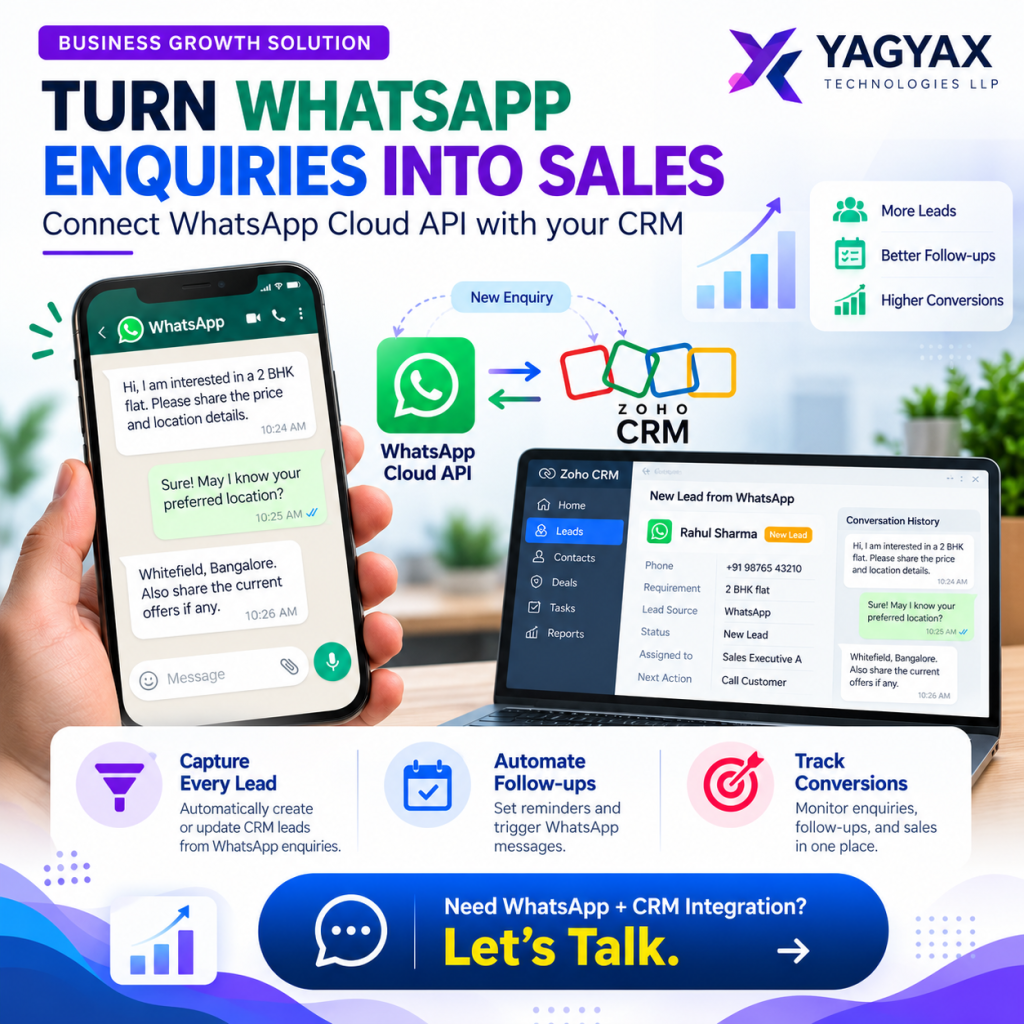
CRM and WhatsApp Cloud API integration can help solve it and deliver measurable business benefits.
1. A Real Business Problem
Consider a company receiving 100 WhatsApp enquiries every day.
Its current process looks like this:
- Customers message the company on WhatsApp.
- Sales representatives reply manually.
- Customer details are copied into Excel or written in notebooks.
- Follow-ups depend on individual employees.
- Managers have limited visibility into pending enquiries.
- Marketing teams struggle to connect advertising spend with actual sales.
The business is receiving enquiries, but it lacks a reliable system to manage them. As a result, leads may be missed, response times may increase, and advertising budgets may generate fewer sales than expected.
2. What Changes After Integration?
With WhatsApp Cloud API connected to a CRM, the workflow becomes more organized and efficient.
Step 1: A customer sends a WhatsApp message
Customer: “I am interested in a 2 BHK flat. Please share the price.”
Step 2: The system captures the enquiry
The integration backend receives the message through a WhatsApp webhook. It identifies the customer and creates a CRM lead, or updates an existing record.
Example CRM record:
| Field | Value |
|---|---|
| Customer | Rahul Sharma |
| Phone | Customer’s WhatsApp number |
| Requirement | 2 BHK flat |
| Lead source | Facebook Ads |
| Status | New Lead |
| Assigned to | Sales Executive A |
| Next action | Call customer |
These are illustrative values, not actual customer data.
Step 3: The salesperson gets the lead
The assigned salesperson can view the lead in the CRM, review the conversation history, and contact the customer without searching through multiple personal phones.
Step 4: Follow-up becomes trackable
If the customer asks for a quotation but does not respond, the CRM can create a follow-up task or trigger an eligible automated message. This reduces the chances of leads being forgotten.
Step 5: The manager sees the outcome
The manager can track new enquiries, contacted leads, site visits, quotations, and confirmed sales in a dashboard.
The company no longer needs to rely entirely on employees remembering every conversation. It gains better control, faster follow-ups, and clearer accountability.
3. What Does the Technical Integration Actually Look Like?
A typical integration has five components:
- WhatsApp Cloud API: Receives and sends WhatsApp messages.
- Webhook: Receives incoming message and delivery-status events from Meta.
- Integration backend: Processes events, identifies customers, and prevents duplicate lead creation.
- CRM API or official CRM plugin: Connects WhatsApp with the CRM. For example, Zoho provides its own official plugins and integrations that can be used where they meet the business requirements.
- Dashboard: Shows lead status, follow-ups, and sales performance.
For example, the backend or official CRM integration can process an incoming message and create or update a lead in Zoho CRM.
The system should store the WhatsApp message ID, handle retries safely, and avoid creating duplicate leads when Meta delivers the same event more than once.
For outgoing messages, the integration can send a WhatsApp message through the Cloud API and record the returned message ID and subsequent delivery-status events.
Using Zoho’s own plugin or official integration can simplify the setup for businesses already using Zoho. However, custom development may still be required for advanced workflows, custom fields, internal APIs, chatbot logic, or business-specific automation.
This technical setup helps businesses maintain accurate customer records, coordinate team activities, and build a reliable sales process.
4. How Can a Business Measure the Benefit?
Suppose a company receives 1,000 enquiries every month.
Before integration, it may not know exactly how many leads received a follow-up or how many became customers.
After integration, it can measure:
- Number of enquiries captured in the CRM
- Percentage of leads contacted
- Average time to first response
- Number of follow-up tasks completed
- Qualified leads and confirmed sales
- Revenue attributed to marketing campaigns
These insights help the business:
- Respond to customers faster
- Reduce missed and duplicate leads
- Improve sales-team productivity
- Identify high-performing marketing campaigns
- Increase accountability among sales representatives
- Make better decisions using real-time data
- Improve customer experience through timely communication
The company can then identify where leads are being lost and improve the process.
Integration does not automatically guarantee higher conversion rates. Its value is that it makes customer management more consistent, measurable, and scalable.
5. Which Businesses Can Use This?
The same approach can be adapted to different industries.
Travel companies: Capture tour enquiries, assign sales representatives, track bookings, and record advance-payment verification.
Educational institutions: Manage admission enquiries, course information requests, counselling appointments, and application follow-ups.
Real estate companies: Track property requirements, site visits, quotations, and negotiations.
Service companies: Capture service requests, assign technicians, schedule appointments, and send status updates.
E-commerce businesses: Connect customer enquiries with order records, customer support, and post-purchase communication.
6. What Does Yagyax Technologies LLP Offer?
Yagyax Technologies LLP can help businesses connect their WhatsApp communication with Zoho CRM, other existing CRMs, or custom business software.
Depending on the business requirements, an implementation may include:
- WhatsApp Cloud API setup and integration
- Zoho CRM plugin or official integration configuration
- CRM lead creation and customer-data synchronization
- Shared team inbox and agent assignment
- Chatbot and AI-powered enquiry handling
- Follow-up automation and message templates
- Integration with booking systems and internal APIs
- Custom reporting and operational dashboards
The implementation starts by understanding how enquiries currently arrive, how the sales team handles them, and where opportunities are being lost.
The solution is then designed around the business workflow rather than forcing the business to change everything at once.
This allows the business to improve its existing process gradually while gaining better visibility, faster response times, and stronger control over customer communication.
Want to See How It Would Work for Your Business?
If your company receives customer enquiries through WhatsApp, we can help you evaluate how to connect those conversations with Zoho CRM or another CRM and your sales process.
Contact Yagyax Technologies LLP to discuss your WhatsApp CRM integration requirements.
Tell us how your team currently handles enquiries, and we can identify whether Zoho’s own plugin is sufficient or whether a custom integration approach would be more suitable for reducing lead loss, improving follow-ups, and increasing sales efficiency.
Introduction
In today’s digital-first business environment, customers expect quick responses, personalized communication, and convenient support. Traditional communication channels such as email and phone support may not always meet these expectations, particularly for businesses handling a large volume of customer enquiries.
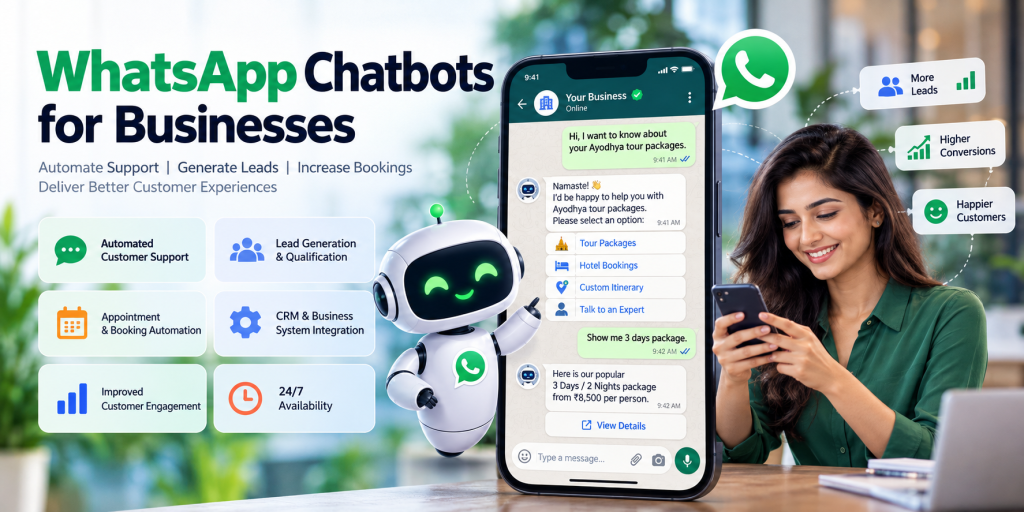
A WhatsApp chatbot for business helps organizations automate conversations, respond to frequently asked questions, qualify leads, and provide customer support through WhatsApp. By combining conversational AI with business workflows, companies can improve operational efficiency while delivering a more seamless customer experience.
What Is a WhatsApp Chatbot?
A WhatsApp chatbot is an automated conversational system that interacts with customers through WhatsApp. It can answer questions, collect customer information, share product details, schedule appointments, and connect users with human support agents when required.
Depending on business requirements, a chatbot can use predefined conversation flows, AI-powered natural language processing, or Large Language Models (LLMs) to understand customer intent and generate relevant responses.
Businesses can deploy chatbots using the WhatsApp Business Platform and integrate them with CRM systems, helpdesk software, booking platforms, and enterprise applications.
Key Benefits of WhatsApp Chatbots for Enterprises
1. Automated Customer Support
A WhatsApp chatbot can handle routine enquiries around the clock, including questions about products, services, business hours, order status, and support requests.
This reduces repetitive work for customer service teams and allows human agents to focus on complex customer issues.
2. Lead Generation and Qualification
Businesses can use WhatsApp chatbots to engage website visitors and advertising leads, understand their requirements, and collect relevant information.
For example, a chatbot can ask prospective customers about their budget, service requirements, preferred location, and purchase timeline. Qualified leads can then be routed to the appropriate sales representative.
3. Improved Customer Engagement
WhatsApp provides a familiar communication channel for customers. Businesses can use automated conversations to share relevant information, answer product questions, and guide customers through their buying journey.
With appropriate consent and messaging practices, businesses can also send permitted notifications and updates.
4. Appointment and Booking Automation
Service-based businesses can automate appointment requests, booking enquiries, availability checks, and confirmation workflows.
Industries such as hospitality, healthcare, education, travel, and professional services can use these capabilities to reduce manual coordination and improve response times.
5. CRM and Business System Integration
An enterprise WhatsApp chatbot becomes more valuable when integrated with existing business systems.
Possible integrations include:
- CRM platforms for lead management
- Helpdesk systems for ticket creation and tracking
- ERP systems for operational information
- Payment gateways for payment workflows
- Booking platforms for reservations
- Knowledge bases for accurate, contextual answers
These integrations help create a connected customer communication workflow instead of an isolated messaging tool.
AI-Powered WhatsApp Chatbots: Beyond Rule-Based Automation
Traditional chatbots follow predefined rules and decision trees. They work well for structured interactions but may struggle when customers ask questions in unexpected ways.
AI-powered WhatsApp chatbots can use natural language understanding and retrieval-augmented generation (RAG) to answer questions using approved business information.
For example, an enterprise chatbot can retrieve relevant information from product documentation, FAQs, policy documents, or internal knowledge bases before generating a response.
A well-designed AI chatbot can include:
- Intent recognition and contextual conversations
- Knowledge-base search and document retrieval
- CRM and API integrations
- Human-agent handoff
- Conversation history and analytics
- Access controls and safeguards against unsupported answers
For business-critical workflows, the chatbot should validate information against reliable systems rather than relying entirely on generated responses.
How WhatsApp Chatbots Work
A typical enterprise WhatsApp chatbot workflow includes the following stages:
- Customer message: A customer sends a message through WhatsApp.
- Message processing: The system identifies the user’s intent and extracts relevant information.
- Business logic or AI retrieval: The chatbot executes predefined workflows or retrieves relevant information from an approved knowledge base.
- System integration: If necessary, the chatbot accesses CRM, booking, ticketing, or other authorized APIs.
- Response generation: The system sends an appropriate answer or requests additional information.
- Escalation and analytics: Complex cases are transferred to human agents, while conversation events are recorded for reporting.
This architecture enables businesses to automate routine interactions while maintaining control over sensitive or complex operations.
Use Cases Across Industries
E-commerce: Product enquiries, order tracking, returns assistance, and sales support.
Travel and hospitality: Hotel enquiries, package information, reservation assistance, and itinerary details.
Healthcare: Appointment requests, clinic information, and permitted reminders, subject to applicable privacy and healthcare requirements.
Education: Admission enquiries, course information, fee-related questions, and student support.
Banking and financial services: General product information, service requests, and carefully controlled customer support workflows.
Enterprise support: Ticket creation, frequently asked questions, service status updates, and internal employee assistance.
WhatsApp Chatbot vs. Traditional Customer Support
| Capability | Traditional support | WhatsApp chatbot |
|---|---|---|
| Availability | Depends on team coverage | Automated responses can operate 24/7 |
| Routine enquiries | Mostly manual | Can be automated |
| Lead qualification | Manual questioning | Structured automated flows |
| System integration | Depends on existing tools | Can connect through APIs |
| Complex issues | Human-led | Human escalation remains essential |
| Analytics | Depends on support systems | Conversation-level analytics can be implemented |
A chatbot is not intended to eliminate human support. The objective is to automate repetitive interactions and help teams respond more effectively.
Security, Privacy, and Compliance Considerations
Enterprise chatbot deployments should incorporate appropriate safeguards for customer information and business operations.
Important considerations include secure API authentication, role-based access controls, data minimization, appropriate retention policies, audit logs, and protection of sensitive information.
Businesses should also follow applicable WhatsApp messaging policies, template requirements, customer consent requirements, and relevant data protection laws. Sensitive actions such as payments, account changes, and access to confidential records should require suitable authorization and validation.
How to Choose the Right WhatsApp Chatbot Solution
Before implementing a chatbot, organizations should evaluate:
- Business objectives: Customer support, lead generation, booking automation, or a combination of use cases.
- Integration requirements: Compatibility with existing CRM, ERP, helpdesk, and booking systems.
- AI capabilities: Whether predefined flows are sufficient or enterprise knowledge retrieval is required.
- Scalability: Ability to support growing conversation volumes and concurrent requests.
- Human handoff: Seamless escalation to customer service and sales teams.
- Reporting: Visibility into response times, lead quality, resolution rates, and conversion performance.
- Security and compliance: Appropriate controls for customer data and messaging workflows.
The best solution is one that addresses measurable business problems rather than simply automating conversations.
Conclusion
WhatsApp chatbots are becoming an important component of modern customer communication strategies. By combining automated workflows, AI-powered responses, and enterprise system integrations, businesses can streamline customer support, improve lead qualification, and deliver more convenient customer experiences.
A successful implementation starts with clearly defined business goals, reliable integrations, appropriate security controls, and a well-planned human escalation process.
Build Smarter Customer Communication with Yagyax Technologies
Yagyax Technologies LLP helps businesses explore technology solutions for customer engagement, workflow automation, and AI-powered business applications.
Whether your organization needs a WhatsApp chatbot for customer support, lead management, booking enquiries, or integration with existing enterprise systems, a solution can be designed around your operational requirements.
Ready to automate your customer conversations? Contact Yagyax Technologies to discuss your WhatsApp chatbot requirements.