WhatsApp Chatbot for Business: Benefits, Use Cases & AI Automation
Introduction
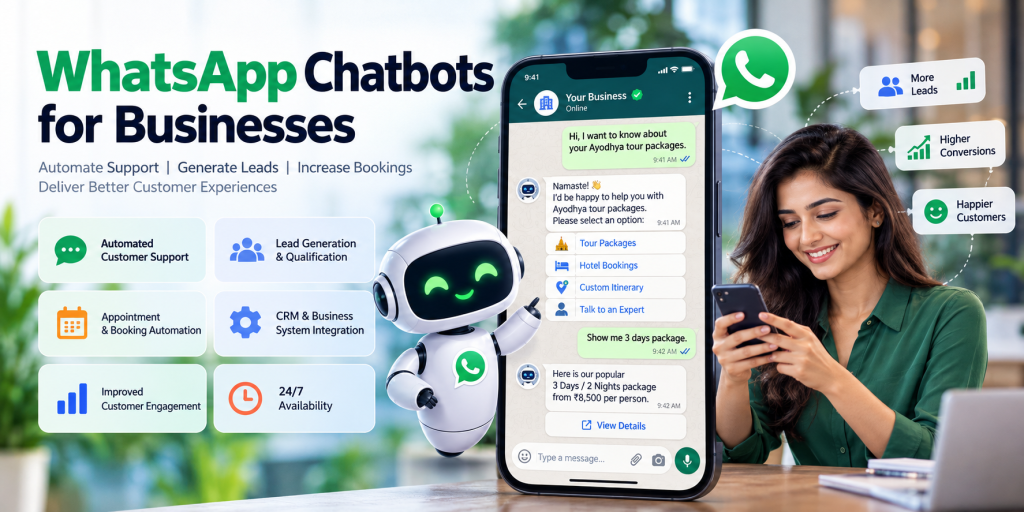
In today’s digital-first business environment, customers expect quick responses, personalized communication, and convenient support. Traditional communication channels such as email and phone support may not always meet these expectations, particularly for businesses handling a large volume of customer enquiries.
A WhatsApp chatbot for business helps organizations automate conversations, respond to frequently asked questions, qualify leads, and provide customer support through WhatsApp. By combining conversational AI with business workflows, companies can improve operational efficiency while delivering a more seamless customer experience.
What Is a WhatsApp Chatbot?
A WhatsApp chatbot is an automated conversational system that interacts with customers through WhatsApp. It can answer questions, collect customer information, share product details, schedule appointments, and connect users with human support agents when required.
Depending on business requirements, a chatbot can use predefined conversation flows, AI-powered natural language processing, or Large Language Models (LLMs) to understand customer intent and generate relevant responses.
Businesses can deploy chatbots using the WhatsApp Business Platform and integrate them with CRM systems, helpdesk software, booking platforms, and enterprise applications.
Key Benefits of WhatsApp Chatbots for Enterprises
1. Automated Customer Support
A WhatsApp chatbot can handle routine enquiries around the clock, including questions about products, services, business hours, order status, and support requests.
This reduces repetitive work for customer service teams and allows human agents to focus on complex customer issues.
2. Lead Generation and Qualification
Businesses can use WhatsApp chatbots to engage website visitors and advertising leads, understand their requirements, and collect relevant information.
For example, a chatbot can ask prospective customers about their budget, service requirements, preferred location, and purchase timeline. Qualified leads can then be routed to the appropriate sales representative.
3. Improved Customer Engagement
WhatsApp provides a familiar communication channel for customers. Businesses can use automated conversations to share relevant information, answer product questions, and guide customers through their buying journey.
With appropriate consent and messaging practices, businesses can also send permitted notifications and updates.
4. Appointment and Booking Automation
Service-based businesses can automate appointment requests, booking enquiries, availability checks, and confirmation workflows.
Industries such as hospitality, healthcare, education, travel, and professional services can use these capabilities to reduce manual coordination and improve response times.
5. CRM and Business System Integration
An enterprise WhatsApp chatbot becomes more valuable when integrated with existing business systems.
Possible integrations include:
- CRM platforms for lead management
- Helpdesk systems for ticket creation and tracking
- ERP systems for operational information
- Payment gateways for payment workflows
- Booking platforms for reservations
- Knowledge bases for accurate, contextual answers
These integrations help create a connected customer communication workflow instead of an isolated messaging tool.
AI-Powered WhatsApp Chatbots: Beyond Rule-Based Automation
Traditional chatbots follow predefined rules and decision trees. They work well for structured interactions but may struggle when customers ask questions in unexpected ways.
AI-powered WhatsApp chatbots can use natural language understanding and retrieval-augmented generation (RAG) to answer questions using approved business information.
For example, an enterprise chatbot can retrieve relevant information from product documentation, FAQs, policy documents, or internal knowledge bases before generating a response.
A well-designed AI chatbot can include:
- Intent recognition and contextual conversations
- Knowledge-base search and document retrieval
- CRM and API integrations
- Human-agent handoff
- Conversation history and analytics
- Access controls and safeguards against unsupported answers
For business-critical workflows, the chatbot should validate information against reliable systems rather than relying entirely on generated responses.
How WhatsApp Chatbots Work
A typical enterprise WhatsApp chatbot workflow includes the following stages:
- Customer message: A customer sends a message through WhatsApp.
- Message processing: The system identifies the user’s intent and extracts relevant information.
- Business logic or AI retrieval: The chatbot executes predefined workflows or retrieves relevant information from an approved knowledge base.
- System integration: If necessary, the chatbot accesses CRM, booking, ticketing, or other authorized APIs.
- Response generation: The system sends an appropriate answer or requests additional information.
- Escalation and analytics: Complex cases are transferred to human agents, while conversation events are recorded for reporting.
This architecture enables businesses to automate routine interactions while maintaining control over sensitive or complex operations.
Use Cases Across Industries
E-commerce: Product enquiries, order tracking, returns assistance, and sales support.
Travel and hospitality: Hotel enquiries, package information, reservation assistance, and itinerary details.
Healthcare: Appointment requests, clinic information, and permitted reminders, subject to applicable privacy and healthcare requirements.
Education: Admission enquiries, course information, fee-related questions, and student support.
Banking and financial services: General product information, service requests, and carefully controlled customer support workflows.
Enterprise support: Ticket creation, frequently asked questions, service status updates, and internal employee assistance.
WhatsApp Chatbot vs. Traditional Customer Support
| Capability | Traditional support | WhatsApp chatbot |
|---|---|---|
| Availability | Depends on team coverage | Automated responses can operate 24/7 |
| Routine enquiries | Mostly manual | Can be automated |
| Lead qualification | Manual questioning | Structured automated flows |
| System integration | Depends on existing tools | Can connect through APIs |
| Complex issues | Human-led | Human escalation remains essential |
| Analytics | Depends on support systems | Conversation-level analytics can be implemented |
A chatbot is not intended to eliminate human support. The objective is to automate repetitive interactions and help teams respond more effectively.
Security, Privacy, and Compliance Considerations
Enterprise chatbot deployments should incorporate appropriate safeguards for customer information and business operations.
Important considerations include secure API authentication, role-based access controls, data minimization, appropriate retention policies, audit logs, and protection of sensitive information.
Businesses should also follow applicable WhatsApp messaging policies, template requirements, customer consent requirements, and relevant data protection laws. Sensitive actions such as payments, account changes, and access to confidential records should require suitable authorization and validation.
How to Choose the Right WhatsApp Chatbot Solution
Before implementing a chatbot, organizations should evaluate:
- Business objectives: Customer support, lead generation, booking automation, or a combination of use cases.
- Integration requirements: Compatibility with existing CRM, ERP, helpdesk, and booking systems.
- AI capabilities: Whether predefined flows are sufficient or enterprise knowledge retrieval is required.
- Scalability: Ability to support growing conversation volumes and concurrent requests.
- Human handoff: Seamless escalation to customer service and sales teams.
- Reporting: Visibility into response times, lead quality, resolution rates, and conversion performance.
- Security and compliance: Appropriate controls for customer data and messaging workflows.
The best solution is one that addresses measurable business problems rather than simply automating conversations.
Conclusion
WhatsApp chatbots are becoming an important component of modern customer communication strategies. By combining automated workflows, AI-powered responses, and enterprise system integrations, businesses can streamline customer support, improve lead qualification, and deliver more convenient customer experiences.
A successful implementation starts with clearly defined business goals, reliable integrations, appropriate security controls, and a well-planned human escalation process.
Build Smarter Customer Communication with Yagyax Technologies
Yagyax Technologies LLP helps businesses explore technology solutions for customer engagement, workflow automation, and AI-powered business applications.
Whether your organization needs a WhatsApp chatbot for customer support, lead management, booking enquiries, or integration with existing enterprise systems, a solution can be designed around your operational requirements.
Ready to automate your customer conversations? Contact Yagyax Technologies to discuss your WhatsApp chatbot requirements.